Operator licence undertakings are the promises you make to the Traffic Commissioner when you apply for a goods vehicle operator licence. The licence is granted on the strength of them, and the Traffic Commissioner is entitled to expect you to keep them for as long as you hold it. The standard ones cover roadworthy vehicles, daily walkaround checks, drivers' licences, drivers' hours, records kept for 15 months, and telling the Traffic Commissioner about changes within 28 days. Break them, and the licence itself is at risk.
This guide explains what undertakings are, lists the standard ones in plain English with what each one means in practice, sets out what happens when they are broken, and ends with a simple monthly checklist.
What an undertaking is
GOV.UK's goods vehicle operator licensing guide says the Traffic Commissioners grant a licence based on the undertakings given by the applicant, and are entitled to expect the operator to comply with them during the life of the licence. Relevant undertakings are written into the licence itself.
An undertaking is different from a condition. A condition is imposed by the Traffic Commissioner, for example limiting how an operating centre is used. An undertaking is a promise you give. Some operators offer extra undertakings to get a licence granted, such as an independent compliance audit; those become part of the licence too.
Either way, the guide is clear that breaking a condition or not keeping an undertaking is a reason for regulatory action.
The standard undertakings, in plain English
The Traffic Commissioners have summarised the standard undertakings every goods vehicle operator signs up to. Here they are, with what each one means day to day.
1. Keep vehicles taxed, insured and in MOT
Every vehicle on the licence has a current tax, insurance policy and annual test. That means knowing the dates for each vehicle and booking ahead. See our HGV compliance checklist for every recurring date.
2. Check drivers have the right licence
Every driver holds the right category for the vehicle they drive, and you check it regularly. The Senior Traffic Commissioner's guidance on transport managers says those checks are usually made every 3 months. See how often to check driving licences.
3. Keep vehicles and trailers roadworthy, and do not overload them
Safety inspections happen at the interval stated on your licence, defects are fixed, and loads stay within each vehicle's plated weights. DVSA's Guide to maintaining roadworthiness sets out what that involves.
4. Obey the drivers' hours and tachograph rules
Drivers keep to the limits on driving, breaks and rest, tachographs are used and calibrated, and you download and check the data. Planning matters here: a trip that cannot be done legally should never be given to a driver.
5. Make sure drivers do a daily walkaround check
Before starting to drive, the driver checks the vehicle, records the check in writing, and reports any defect. See our guide to the DVSA walkaround check.
6. Keep maintenance and driver check records for 15 months
Safety inspection records, driver defect reports and the repairs that followed are kept for at least 15 months, including for vehicles you no longer operate. Electronic records are acceptable if they are available for the full period.
7. Stay within your authorised number of vehicles
You do not operate more vehicles or trailers than the licence allows. Growing the fleet means applying to increase your authorisation first.
8. Operate only from your authorised operating centres
Vehicles are kept at the operating centres named on the licence. Parking a lorry somewhere else as a regular base is a breach.
9. Tell the Traffic Commissioner about changes within 28 days
GOV.UK lists the changes, including a change of transport manager, correspondence address or operating centre address, a change of legal entity, bankruptcy or liquidation, and relevant convictions. Changes are made through the online vehicle operator licensing service.
What happens if you break an undertaking
Evidence of a broken undertaking usually reaches the Traffic Commissioner from DVSA, after a roadside check, a prohibition or an investigation. GOV.UK says your licence could be taken away, suspended or restricted if you break its terms or conditions, and that the Traffic Commissioner may call you to a public inquiry.
The range of outcomes is wide:
- no action, or a formal warning
- extra undertakings or conditions, such as an independent audit
- a reduction in the number of vehicles you are authorised to run
- suspension of the licence for a period
- revocation of the licence
- disqualification of the operator, directors or transport manager
The Senior Traffic Commissioner's principles of decision making explain how they decide. The pattern in published decisions is consistent: an operator who finds its own problems, puts them right and can show it fares far better than one whose problems are found by DVSA.
Where small hauliers slip
Undertakings are rarely broken on purpose. They slip because a small team is busy:
- One extra vehicle. A hired lorry covers a busy fortnight and takes the fleet over its authorisation.
- Parking at home. A driver takes the lorry home every night, away from the operating centre.
- A new transport manager nobody told the Traffic Commissioner about.
- Walkaround checks that become a signature. The sheet is signed every morning, but nobody looked at the tyres.
- Defects reported, never fixed, or fixed with no record of it.
- Licence checks done once, at recruitment, and never again.
A monthly undertakings checklist
Run through this on the same day every month, and keep a note that you did.
| Undertaking | Monthly question |
|---|---|
| Taxed, insured, tested | Does any vehicle's tax, insurance or annual test run out in the next 3 months? |
| Driver licences | Has every driver been checked in line with your policy? |
| Roadworthy, not overloaded | Were all safety inspections done on time, and every defect fixed? |
| Drivers' hours and tachographs | Was tachograph data downloaded and checked, and every infringement followed up? |
| Walkaround checks | Did every driver complete a check before every use? Who never reports a defect? |
| Records for 15 months | Can you produce the last 15 months for any one vehicle today? |
| Vehicle authorisation | Are you within the number of vehicles and trailers on your licence? |
| Operating centres | Are all vehicles kept at an authorised operating centre? |
| Changes within 28 days | Has anything changed that the Traffic Commissioner needs to know? |
How Orca helps you keep your undertakings
Orca does not replace your transport manager's judgement, but it makes several undertakings much easier to evidence.
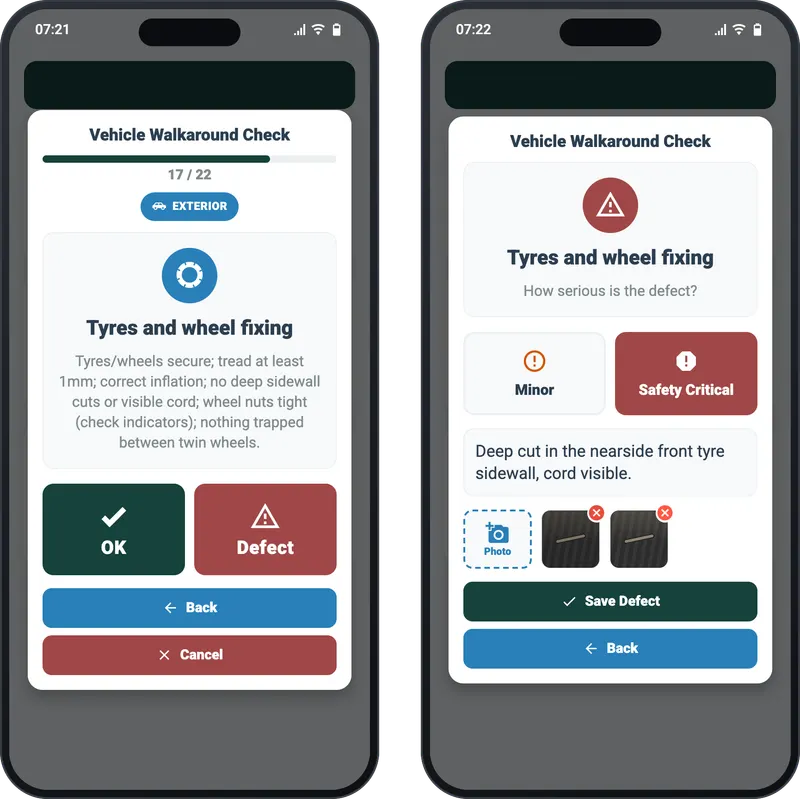
- Walkaround checks (undertaking 5). The driver app can require the DVSA walkaround check before a trip starts. Each item is answered in DVSA order, and a defect is graded, described and photographed.
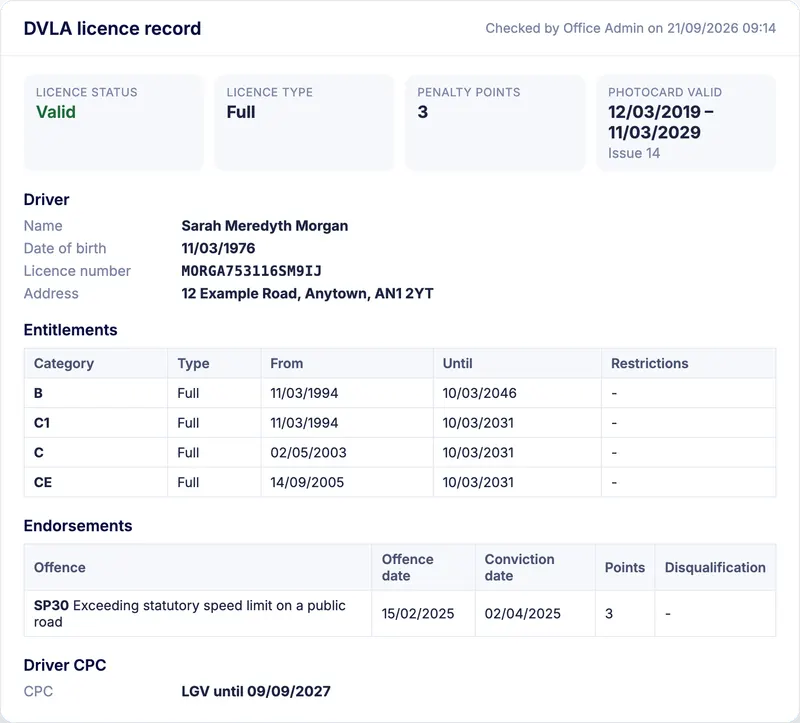
- Driver licences (undertaking 2). DVLA licence checks run from Orca, showing each driver's entitlements, points and endorsements, with every check recorded.
- Tax and MOT (undertaking 1). One button fetches a vehicle's tax status and due date from DVLA, along with MOT status and expiry where DVLA holds them, and saves them on the vehicle.
- Records (undertaking 6). Walkaround checks and defects are kept against each vehicle, so the history for one vehicle is in one place.
- Driver documents. Orca messages the fleet manager on WhatsApp each morning about driver licence, insurance and right to work documents that have expired or expire within 2 months.
Frequently asked questions
What are operator licence undertakings?
They are promises an operator gives the Traffic Commissioner when applying for a goods vehicle operator licence, such as keeping vehicles roadworthy, making sure drivers do daily walkaround checks and keeping records for 15 months. The licence is granted on the basis of them.
What is the difference between a condition and an undertaking?
A condition is imposed on the licence by the Traffic Commissioner. An undertaking is a promise the operator gives. Breaking either can lead to regulatory action.
What happens if I break an undertaking on my operator licence?
The Traffic Commissioner can take regulatory action, often after a public inquiry. Outcomes range from a warning to suspension, revocation and disqualification.
How long do I have to tell the Traffic Commissioner about a change?
28 days, for relevant changes such as a new transport manager, a new address, a change of legal entity, bankruptcy or liquidation, or relevant convictions.
Can I keep a lorry at a driver's home overnight?
Not as a regular base unless that address is an authorised operating centre on your licence. Operating only from authorised operating centres is one of the standard undertakings.
Orca brings walkaround checks, driver licence checks, vehicle data and trips into one system for UK operators. See Orca for transport and logistics, or get in touch to see how it supports your licence.