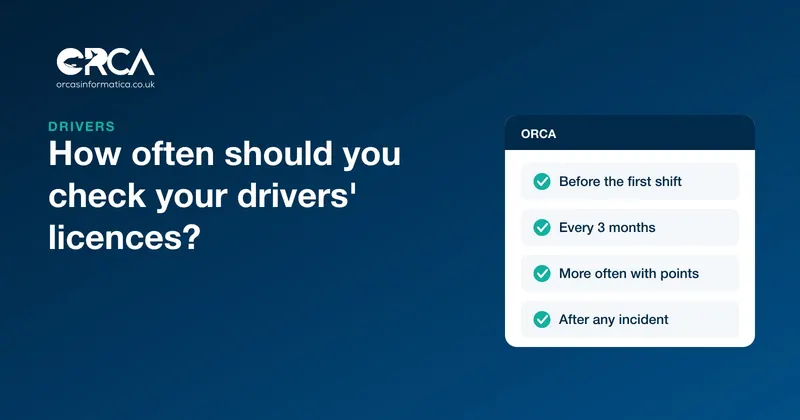
How often should you check your drivers' licences? The law does not set a fixed interval, but the Traffic Commissioners do set an expectation: their statutory guidance says a transport manager should make sure regular checks are carried out on drivers' licences, usually every 3 months. For most UK operators that is the baseline, with extra checks before a driver's first shift, for drivers carrying penalty points, and after any incident.
This guide explains where that expectation comes from, how to build a risk-based schedule on top of it, and how to keep the evidence that shows you stuck to it. If you are new to licence checks altogether, start with our complete guide to driver licence checks with DVLA.
What the rules actually say about driver licence check frequency
Three sources shape the answer, and only one of them names a number.
Employment law and health and safety. GOV.UK says employers must make sure anyone they employ to drive has the right licence and qualifications. The Health and Safety Executive (HSE) lists driving offences and making sure licences are up to date among the things employers should consider when assessing drivers. Neither sets an interval.
The Traffic Commissioners. If you hold a goods vehicle operator licence, the Traffic Commissioners are the people who decide whether you keep it. Their Statutory Document 3 on transport managers lists a transport manager's general responsibilities. Under drivers, it includes:
- making sure drivers hold the appropriate licence for the vehicle they are driving
- making sure regular checks are carried out on drivers' licences (usually every 3 months)
That "usually every 3 months" is the closest thing to an official frequency in UK road transport. A Traffic Commissioner at a public inquiry will ask what your checks were and how often you made them. A quarterly routine, written down and followed, is the answer they expect to hear.
Your insurer. Fleet policies often include their own conditions on licence checks. Read your policy: if it names a frequency, that becomes your minimum.
Why every 3 months, and not once a year?
A driving licence changes without the card in the driver's wallet changing. Penalty points are added, categories expire and drivers are disqualified, and none of it shows on the photocard. The numbers move quickly enough that an annual check leaves a long blind spot:
- A driver can be disqualified for building up 12 or more penalty points within 3 years.
- A new driver's licence is cancelled if they get 6 or more points within 2 years of passing their test.
- Endorsements stay on the record for 4 or 11 years, depending on the offence.
- Lorry and bus entitlements expire on their own cycle, separate from the car licence.
With a yearly check, a driver disqualified in month two could drive for you for ten months before you find out. With quarterly checks, the gap is never more than three months, and with risk-based extra checks it is shorter still for the drivers most likely to change.
A risk-based licence check schedule
Use the Traffic Commissioners' 3 months as the default, then check more often where the risk is higher. Official guidance does not give point bands, so the table below is our suggestion. Adapt it to your fleet and your insurer's conditions, and write your version into your policy.
| Driver | Suggested check frequency |
|---|---|
| New starter | Before their first shift, then as below |
| No penalty points | Every 3 months |
| 1 to 5 penalty points | Every 3 months, reviewed by a manager |
| 6 to 8 penalty points | Every month |
| 9 or more penalty points | Every month, with a conversation about risk |
| New driver within 2 years of passing | Every month |
| Entitlement or Driver CPC close to expiry | Before the expiry date, then as above |
Some events call for a check straight away, whatever the schedule says:
- Before the first shift. Never let anyone drive on the strength of a photocopy or a promise.
- After an accident or incident, or a report of poor driving.
- When a driver changes vehicle type, for example from a 7.5 tonne lorry to an articulated one, so you confirm the category before they drive it.
- When a driver tells you about an offence. Your policy should require them to.
- When an agency driver or subcontractor drives for you for the first time.
How to check, and how quickly
The method you use decides how practical a 3-month schedule is.
- Check codes. The driver creates a check code on GOV.UK and shares it with you. It is free and valid for 21 days, but it depends on every driver doing it every quarter, and on someone chasing the ones who forget.
- Access to Driver Data (ADD). DVLA's direct service for businesses lets you check a driver's record whenever you need to, once they have signed a consent declaration. It is the practical way to check a whole fleet every quarter, or every month for higher risk drivers.
With check codes, a 20-driver fleet means 80 codes to chase every year. With ADD, it means 80 clicks.
Proving you kept to your schedule
A schedule only protects you if you can show you followed it. For every driver, keep:
- The signed consent, with the date it was given and when it runs out.
- Every check: who ran it, when, and what it showed (licence status, categories, points and any disqualification).
- What you did about it: a conversation, a restriction, a move to monthly checks, or a decision not to let them drive.
- Your written policy, so anyone can see the frequency you chose and why.
Licence data is personal data. Keep it secure, limit who can see it and handle it in line with the UK GDPR.
What goes wrong
The same gaps come up again and again:
- Checks that drift. A quarterly routine slips to "when we remember", and the last check on file is fourteen months old.
- No evidence. The check was done on screen, but nothing was saved.
- Missed new starters and agency drivers, because they joined between checking rounds.
- Expired consent. An ADD consent has run out, so the check cannot be made on the day it is needed.
- Points noted, nothing done. The check shows 9 points and the driver stays on the same schedule.
Every one of these is a question a Traffic Commissioner, an insurer or the HSE can ask after something goes wrong.
How Orca keeps licence checks on schedule
Orca has DVLA licence checks built in, through Orca Informatica's own Access to Driver Data account, so you can check a driver's record from the office without applying for DVLA accreditation yourself.
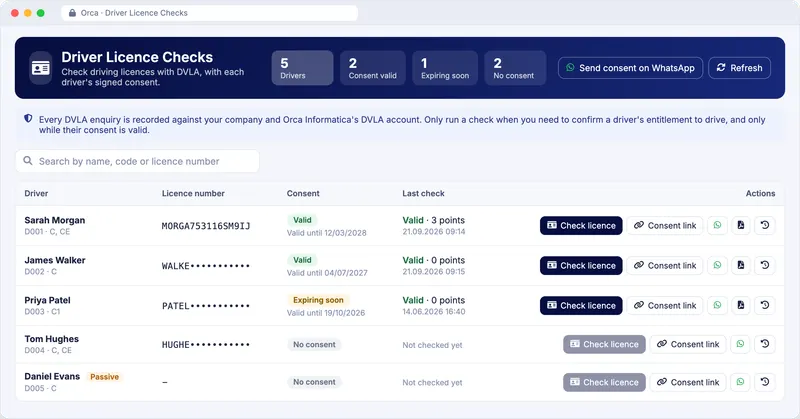
- See who is due. The Driver Licence Checks screen lists every driver with their consent status and the result of their last check, including penalty points, so the drivers due a check stand out.
- Consent that does not stall. You send a consent link from the screen, on WhatsApp or in any message, and the driver signs on their phone. A consent lasts 2 years, and the counts at the top show whose consent is expiring soon, so you can renew it before a check is due.
- One click per check. With a valid consent, a check returns the DVLA record laid out to read: status, entitlements, endorsements and points. You can include Driver CPC and tachograph cards in the same check.
- Every check on record. Orca records who ran each check, when, under which consent and what DVLA returned, so you can show your schedule was followed.
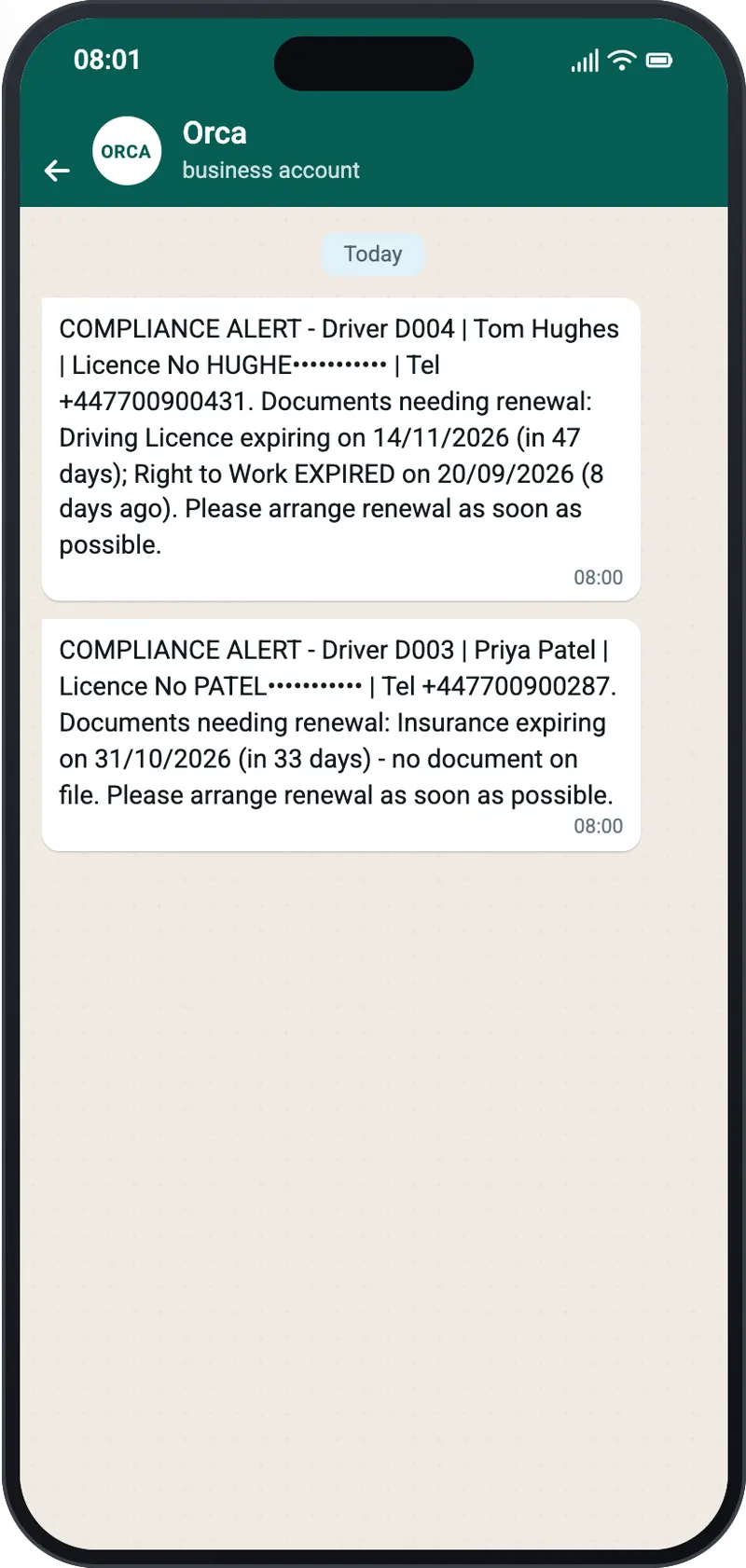
Licence checks are one part of driver compliance. Orca also keeps each driver's licence, insurance and right to work documents with their expiry dates, and every morning sends the fleet manager a WhatsApp message listing anything expired or expiring within the next 2 months.
A licence check routine you can adopt today
- Write your frequency into your driver policy: every 3 months as standard, monthly for higher risk drivers.
- Check every new starter, agency driver and subcontractor before they drive.
- Put the next checking round in the diary as soon as one finishes.
- Renew consents before they expire.
- Record every check and every action you took because of one.
- Review the policy once a year, and whenever your insurer changes its conditions.
Licence checks sit alongside vehicle checks. For the vehicle side, see our guide to the DVSA walkaround check.
Frequently asked questions
Is there a legal requirement to check driving licences every 3 months?
No law sets a fixed interval. The Traffic Commissioners' statutory guidance says a transport manager should make sure regular checks are carried out on drivers' licences, usually every 3 months, so that is what operators are expected to do.
How often should I check a driver with penalty points?
Official guidance does not set bands by points. We suggest monthly checks for drivers with 6 or more points, and for new drivers within 2 years of passing, because their licence can be cancelled at 6 points.
Do I need to check van drivers as well as HGV drivers?
Yes. The duty to make sure anyone you employ to drive has the right licence applies to every driver, whatever they drive. The Traffic Commissioners' expectation applies to operator licence holders, but a regular routine is sensible for any fleet.
How long is a driver's consent for an ADD check valid?
DVLA requires a signed declaration before an Access to Driver Data check. In Orca a consent lasts 2 years, and the screen shows which consents are expiring soon so they can be renewed in time.
Should agency drivers be checked too?
Yes. If they drive for you, you need to know they hold the right licence. Check them before their first shift, and make sure your agreement with the agency covers who checks and how often.
Orca brings driver licence checks, document expiry alerts, walkaround checks and trip planning into one system for UK operators. See Orca for transport and logistics, or get in touch to switch on DVLA licence checks for your drivers.