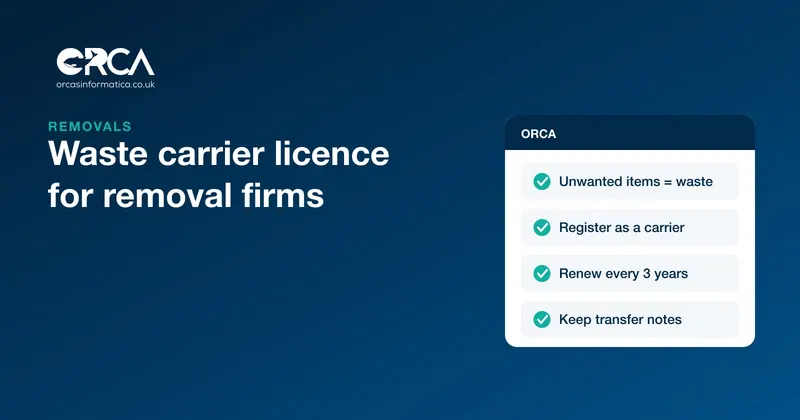
Does a removal company need a waste carrier licence? If it only moves customers' belongings from one home to another, no: those belongings are not waste. But the moment a customer asks you to take away the old sofa, the broken wardrobe or the bags from the loft clear-out, you are carrying their waste, and in England you must be registered as a waste carrier. Carrying other people's waste without registering is an offence, with an unlimited fine.
This guide explains when unwanted items become waste, which registration a removal firm needs, what it costs, the paperwork that goes with every load, and how to stay covered.
When unwanted items become waste
GOV.UK's guidance on checking if your material is waste says a material is waste if the holder has discarded it. The holder is whoever has it at the moment it is discarded, which on moving day is your customer.
In practice, for a removals job:
| Situation | Waste? |
|---|---|
| Furniture moved from the old home to the new home | No |
| Items put into storage for the customer | No |
| A sofa the customer no longer wants, taken to the tip | Yes |
| Garden rubbish, broken items and bags from a clear-out | Yes |
| An old mattress left behind for you to dispose of | Yes |
The grey area is reuse. GOV.UK's guidance says a material does not become waste if, among other conditions, the previous holder intended it to be reused for the same purpose it was designed for. A working wardrobe the customer is giving to a charity shop may not be waste; a broken one going to the tip is. If you are not sure, treat it as waste and make sure you are covered.
Which registration a removal firm needs
In England, you must register with the Environment Agency if you transport waste (a carrier), buy, sell or dispose of it (a dealer), or arrange for someone else to do so (a broker). GOV.UK says:
- registration is usually free if you only transport waste you produce yourself
- otherwise, a new registration costs £191.02
- when you register, you are told whether it is upper tier or lower tier
- upper tier registrations must be renewed every 3 years, at £130.25; lower tier registrations do not need renewing
A removal firm taking customers' unwanted items is transporting other people's waste, so it falls into the paid registration rather than the free one. Register before you take the first load, not after.
Scotland, Wales and Northern Ireland
Registration is handled by a different regulator in each nation: the Scottish Environment Protection Agency (SEPA), Natural Resources Wales and, in Northern Ireland, the Department of Agriculture, Environment and Rural Affairs (DAERA). The principle is the same, but the fees and forms differ, so register where your business is based and check the rules for each nation you collect from.
Changes on the way
The government has published plans to reform the waste carrier, broker and dealer system, replacing registrations with permits. If you hold an upper tier registration, the Environment Agency expects to contact you about the change. Keep an eye on it when your registration comes up for renewal.
The paperwork: waste transfer notes
Every time waste changes hands, the waste duty of care applies. For business waste, GOV.UK says a waste transfer note must be completed and signed by both parties, with enough information for the next holder to handle the waste safely, and kept for 2 years, ready to show a council or Environment Agency officer.
For a removal firm, that means two things:
- When you take waste from a business customer, such as an office move, there should be a transfer note between the customer and you.
- When you hand waste on, to a recycling centre that accepts trade waste or a licensed waste site, there should be a transfer note between you and them.
Household recycling centres often do not accept trade waste from vans, so check where you can take it before you quote for the job.
Putting waste into the quote
Waste removal is easiest to get right when it is agreed before moving day rather than on the doorstep. A few habits help:
- Ask at the survey. During the home or video survey, ask what is not coming to the new home, and list it separately from the move.
- Price it as its own line. Disposal has real costs: the time to load it, the trip to a licensed site and the site's charges. A separate line makes that clear to the customer and protects your margin.
- Say where it is going. Tell the customer whether items are going to a licensed waste site, a recycler or a charity for reuse.
- Check for hazardous items early. Fridges, freezers, paint and batteries can need specialist disposal. Find out before you agree a price.
- Give the crew the list. On the day, the crew should know exactly which items are waste, so nothing that was meant for the new home ends up at the tip, and nothing extra goes on the van unagreed.
Handled this way, waste removal stops being a favour done on the day and becomes a service you are registered for, have priced and can prove.
Why your customers care
Householders have a duty of care too. If waste is fly-tipped and traced back to a household that handed it to an unregistered carrier, the householder can be fined. Councils can issue a fixed penalty of up to £600 for this; South Cambridgeshire, for example, fined a resident £600 for not checking that a man with a van was a licensed waste carrier.
That makes registration a selling point. Councils tell residents to check the public register of waste carriers before handing over waste. Put your registration number on your quotes and website, and your customers can check you in seconds.
What goes wrong
- The "while you're here" job. A crew agrees on the day to take the old fridge, and the firm is not registered.
- A lapsed upper tier registration, because nobody noted the 3-year renewal date.
- No transfer notes, so there is no record of where the waste went.
- Waste taken to a household site that does not accept trade waste.
- Hazardous items. Fridges, paint, batteries and some electrical items have their own rules. Check before you take them.
How Orca helps
Orca does not register you as a waste carrier, but it keeps the job record that shows what you moved and where.
- What was moved. Each order lists its items with their description, quantity, weight and volume, so items going to disposal can be recorded separately from items going to the new home.
- Where it went. Each order records the collection and delivery addresses, and each trip records the vehicle, the driver and the date.
- Who signed. Orders can be signed for on delivery, giving you a record that the job was completed.
When an officer asks where a load of waste went, the answer is in the job, alongside your transfer note.
See Orca for removals companies for the moving side, and our guide to whether removal companies need an operator licence.
A checklist for taking waste away
- Register as a waste carrier before you take any customer's unwanted items.
- Note your renewal date if you are upper tier, and renew every 3 years.
- Put your registration number on quotes, invoices and your website.
- Agree in the quote which items are waste and where they will go.
- Complete a transfer note for business customers and when you hand waste on.
- Keep transfer notes for 2 years.
- Check hazardous items before you agree to take them.
- Record the waste items on the job, separately from the move.
Frequently asked questions
Do removal companies need a waste carrier licence?
Not for moving belongings, which are not waste. If you take away items the customer is getting rid of, you are carrying their waste, and in England you must be registered with the Environment Agency.
How much does a waste carrier licence cost?
In England, GOV.UK says registration is usually free if you only carry waste you produce yourself. Otherwise it costs £191.02, and an upper tier registration is renewed every 3 years for £130.25.
What is the penalty for carrying waste without a licence?
GOV.UK says you can get an unlimited fine if you do not register.
How long should waste transfer notes be kept?
2 years, in paper or electronic form, ready to show a council or Environment Agency officer.
How can customers check that I am a registered waste carrier?
They can search the Environment Agency's public register of waste carriers, brokers and dealers online. Put your registration number on your quotes to make it easy.
Orca brings removals jobs, items, addresses and signed deliveries into one system. See Orca for removals companies, or get in touch to see it running on your own jobs.