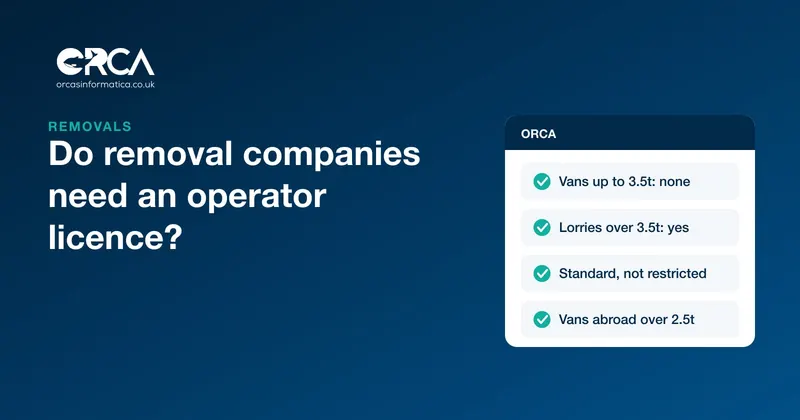
Do removal companies need an operator licence? In Great Britain, yes, as soon as they use a goods vehicle with a gross plated weight over 3,500 kg (3.5 tonnes). A removals firm carries its customers' belongings, which are other people's goods, so it needs a standard operator licence, not a restricted one. A firm that only uses vans up to 3.5 tonnes in Great Britain does not need an operator licence at all, although the moment it takes a van over 2.5 tonnes abroad for a customer, the rules change.
This guide explains the weight threshold, the types of licence, where movers most often get caught out, and what holding a licence means for the way you run the business day to day.
The 3.5 tonne threshold
GOV.UK says you need a goods vehicle operator licence if your business uses:
- a vehicle with a gross plated weight over 3,500 kg, or, if it has no plated weight, an unladen weight over 1,525 kg
- a vehicle and trailer combination whose plated weights add up to more than 3,500 kg, or whose unladen weights add up to more than 1,525 kg
The figure that counts is the plated weight (the maximum the vehicle is allowed to weigh fully loaded), not what it weighs on the day. A 7.5 tonne removals lorry needs an operator licence even when it is driving home empty.
For most movers that means:
| Vehicle | Operator licence needed in Great Britain? |
|---|---|
| Panel van or Luton van up to 3.5 tonnes | No |
| Van towing a trailer, combined over 3.5 tonnes | Yes |
| 7.5 tonne removals lorry | Yes |
| 18 tonne or larger pantechnicon | Yes |
Which licence does a removals firm need?
There are three types of operator licence:
- Restricted: you can carry your own goods, but not other people's goods.
- Standard national: you can carry your own goods and other people's goods in the UK.
- Standard international: you can carry your own goods and other people's goods in the UK and on international journeys.
A removals company is paid to move its customers' furniture and belongings. Those are other people's goods, so a restricted licence does not cover it. A firm moving people within the UK needs a standard national licence. A firm that also does European removals needs a standard international licence.
What a standard licence involves
A standard licence asks more of you than a restricted one:
- A transport manager. Operators with a standard licence need a transport manager who holds the Transport Manager Certificate of Professional Competence (CPC). It can be you, an employee, or an external transport manager on contract. An external transport manager can work for up to 4 operators, with no more than 50 vehicles in total.
- Financial standing. You must show you have enough money available to run and maintain the vehicles, for the first vehicle and for each extra one.
- An operating centre. Each place you normally keep the vehicles must be named on the licence and advertised.
- Good repute. The business and the transport manager must be of good repute, as judged by the Traffic Commissioner.
The application is made online. GOV.UK says you will usually get a decision within 7 weeks, and longer if documents are missing. Current fees are £257 to apply and £401 to issue the licence, with a £401 continuation fee every 5 years.
Vans, trailers and the grey areas for small movers
Most small removals firms and man-and-van businesses start with vans, and that is where the questions arise.
A Luton van at 3.5 tonnes
A Luton van plated at 3,500 kg does not need an operator licence in Great Britain, and can be driven on a standard car (category B) licence. It is easy to overload, though: a full Luton with two crew aboard can go over its plated weight, and that is an offence whatever licence you hold.
Towing a trailer
Hitch a trailer to a 3.5 tonne van and the combination can go over 3,500 kg. Once the plated weights add up to more than that, you need an operator licence, and your drivers may need a different driving licence category too.
Taking a van abroad
Since the rules changed for vans, a firm that carries other people's goods for hire or reward in Europe needs a standard international licence if it uses a van with a maximum authorised mass over 2,500 kg, or a van or car towing a trailer with a combined weight over 2,500 kg. That covers the EU, Iceland, Liechtenstein, Norway and Switzerland. A small mover taking one customer's belongings to Spain in a 3.5 tonne van is caught by this.
Electric vans
Some zero emission goods vehicles used only in England, Scotland and Wales are exempt from operator licensing up to a higher weight limit than diesel vans. If you are buying electric, check the exemptions against the exact vehicle before you assume it is covered.
Growing past 3.5 tonnes
The common trap is growth. A firm that has always used vans buys its first 7.5 tonne lorry and puts it straight to work. From that day it needs a standard licence, a transport manager and an operating centre, and the vehicle needs a tachograph.
The driving licence side
The operator licence is about the business. Each driver also needs the right category on their own driving licence:
- Category B covers vehicles up to 3,500 kg.
- Category C1 covers vehicles between 3,500 kg and 7,500 kg, so a 7.5 tonne removals lorry needs C1.
- Category C covers anything heavier.
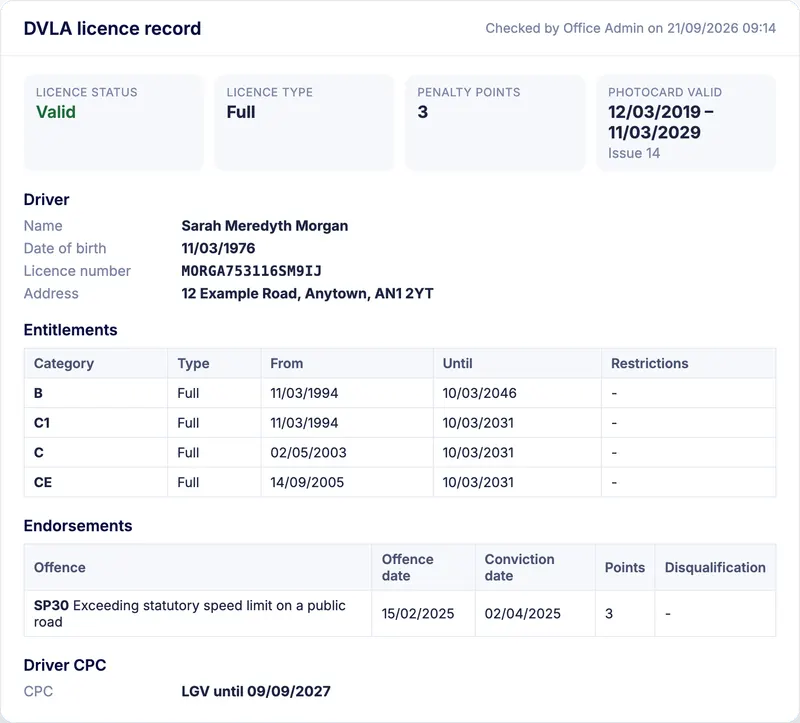
Drivers who passed their car test before 1 January 1997 may already have C1 on their licence. Never assume: check the categories on the driver's DVLA record before they drive, and keep checking (see our guide to how often to check driving licences). Professional lorry drivers also need a Driver CPC.
What happens if you operate without a licence
Using a goods vehicle that needs an operator licence without one is an offence. DVSA can detain (impound) a goods vehicle used without a licence, under powers explained in the Senior Traffic Commissioner's guidance on impounding, and running unlicensed makes it harder to get a licence later, because the Traffic Commissioner looks at your history when judging repute. It can also put your insurance in doubt.
What holding a licence means day to day
A licence is a set of promises. When you hold one, the Traffic Commissioner expects you to:
- keep vehicles roadworthy, with safety inspections at set intervals and the records to prove it
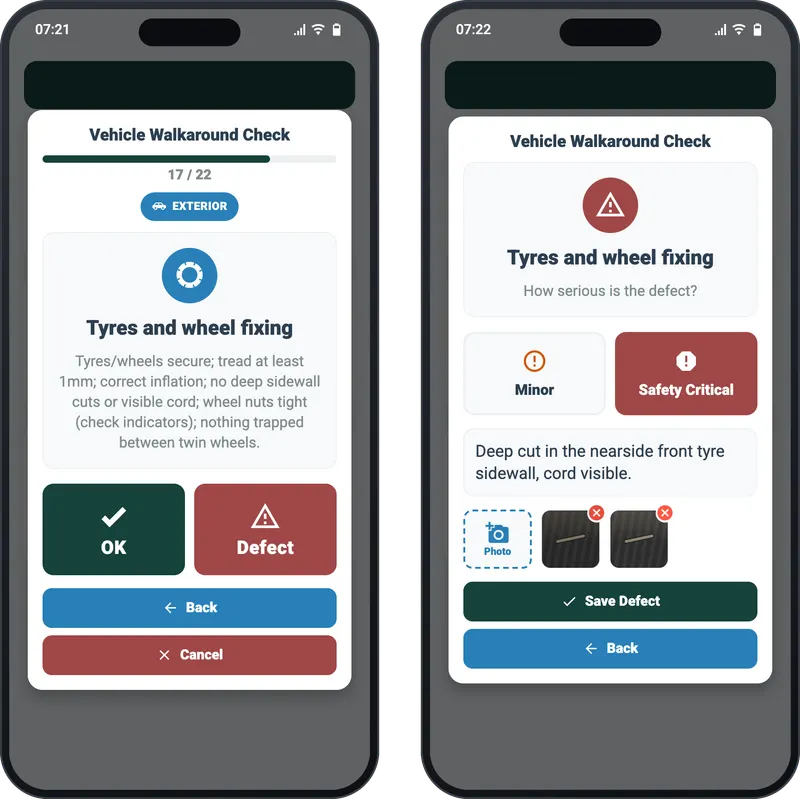
- make sure drivers do a walkaround check before using a vehicle, and report defects
- make sure drivers hold the right licence, and check it regularly
- keep to the drivers' hours and tachograph rules for vehicles over 3.5 tonnes
- keep the records, and be able to find them
For a removals firm used to running everything from a diary and a WhatsApp group, this is the real change. The licence application is a few weeks of paperwork. Showing continuous and effective control of the operation, every week, is the ongoing job.
How Orca helps a removals firm stay on top of it
Orca keeps the jobs, the vehicles and the drivers in one system, so the records an operator licence asks for are kept as part of the work rather than in a separate folder.
- Vehicles with their DVLA data. From a vehicle's record, one button fetches its details from DVLA, including tax status and due date and MOT status and expiry date, and saves them on the vehicle record.
- Driver licence checks. Check each driver's DVLA record, including the categories they hold, so you know who can drive the 7.5 tonne lorry and who can only drive the van.
- Walkaround checks before the trip. The driver app can require the DVSA walkaround check before a trip starts, with defects graded and photographed.
- Jobs on record. Each order records the collection and delivery addresses, the items, and whether furniture needs dismantling or assembly, and each trip records the vehicle, the driver and the dates.
See Orca for removals companies for the moving side, from survey to invoice.
A checklist before you buy a bigger vehicle
- Check the plated weight of the vehicle, and of any trailer you will tow.
- If it is over 3,500 kg, apply for a standard national licence before it goes on the road.
- Name a qualified transport manager.
- Make sure you can show financial standing for every vehicle.
- Confirm your operating centre and advertise it.
- Check every driver holds the right category, and Driver CPC if needed.
- Set up maintenance inspections, walkaround checks and record keeping.
- If you will work in Europe with vans over 2.5 tonnes, get a standard international licence.
Frequently asked questions
Do I need an operator licence for a 3.5 tonne Luton van?
Not in Great Britain, as long as its gross plated weight is no more than 3,500 kg and you do not tow a trailer that takes the combination over that weight. You will need a standard international licence to carry customers' goods into Europe in a van over 2,500 kg.
Can a removals company use a restricted operator licence?
No. A restricted licence only lets you carry your own goods. Moving a customer's belongings for payment is carrying other people's goods, so a removals firm needs a standard national or standard international licence.
Do I need a transport manager for a removals business?
Yes, if you hold a standard licence. The transport manager must hold the Transport Manager CPC and have continuous and effective control of the transport operation. They can be in-house or external.
How long does it take to get an operator licence?
GOV.UK says you will usually get a decision within 7 weeks, and longer if your application is incomplete. Apply well before you need the vehicle on the road.
Can my drivers drive a 7.5 tonne lorry on a car licence?
Only if their licence shows category C1. Drivers who passed their car test before 1 January 1997 may have it; most who passed later do not. Check each driver's DVLA record before they drive.
Orca brings removals jobs, vehicles, driver checks and walkaround checks into one system. See Orca for removals companies and Orca for transport and logistics, or get in touch to see it running on your own jobs.