Traffic Commissioner record keeping comes down to one question: can you prove, on paper or on screen, that your vehicles were safe and your drivers were legal on any day you choose? An operator licence holder promises to keep vehicle maintenance and driver defect records for at least 15 months, to check that drivers hold the right licence, and to keep to the drivers' hours rules. When DVSA examines an operator or a Traffic Commissioner calls a public inquiry, the records are the evidence. Missing or patchy records are treated as a sign of missing control.
This guide covers who the Traffic Commissioners are, which records they expect, how long to keep them, the failings that come up again and again at public inquiries, and what an "effective system" looks like in practice.
Who the Traffic Commissioners are
The Traffic Commissioners for Great Britain license and regulate the operators of lorries, buses and coaches. They grant operator licences, and they can take them away. Evidence usually reaches them from the Driver and Vehicle Standards Agency (DVSA), for example after a roadside check, a prohibition or a maintenance investigation. Where it is needed, a Traffic Commissioner calls the operator to a public inquiry.
GOV.UK sets out what can happen if you break the terms of your licence: it can be taken away, suspended or restricted. Operators and transport managers can also be disqualified. The Senior Traffic Commissioner's principles of decision making explain how they decide.
The promises behind the records
Every operator agrees to a set of standard undertakings when they apply for a licence. The Traffic Commissioners' own summary lists them, including to:
- keep vehicles taxed, insured and in MOT
- check that drivers have the right licence
- keep vehicles and trailers roadworthy and not overload them
- obey the drivers' hours and tachograph rules
- make sure drivers do a daily walkaround check, recorded in writing, before starting to drive
- keep vehicle maintenance and driver check records for 15 months
- tell the Traffic Commissioner about certain changes within 28 days
Each undertaking needs evidence. A promise to keep vehicles roadworthy is proved by inspection records. A promise to check licences is proved by a record of the checks. If the record does not exist, neither does the proof.
Which records to keep, and for how long
| Record | Keep for at least | Source |
|---|---|---|
| Safety inspection records, for every vehicle and trailer | 15 months | Guide to maintaining roadworthiness |
| Driver defect reports, with the repair details | 15 months | Guide to maintaining roadworthiness |
| Braking risk assessments, where used | 15 months | Guide to maintaining roadworthiness |
| Drivers' hours records | 12 months | Statutory Document 3 |
| Driver licence checks | Your policy, made regularly, usually every 3 months | Statutory Document 3 |
Two details are often missed. Safety inspection records must be kept for 15 months even for vehicles you have sold or taken off the licence. And electronic records are acceptable, as long as they are available for the full 15 months along with the record of any repair.
What DVSA looks at in a maintenance investigation
DVSA publishes the questions its examiners work through when they investigate an operator. Several are about records and systems:
- Are maintenance records suitable, available and complete?
- Is there an effective forward planning system, so inspection, annual test and calibration dates are planned ahead?
- Is there a robust vehicle off the road system?
- Are effective walkaround checks being carried out, is there a suitable system for drivers to report defects, and are defects assessed and repaired?
- Are inspection intervals satisfactory, and are they being kept to?
- Does the transport manager provide effective management control?
Read the list as an exam paper published in advance. Each question is answered with a record.
The failings that come up at public inquiries
The Traffic Commissioners publish their decisions, and the same themes appear again and again. In one revocation published in May 2026, a deputy Traffic Commissioner found that vehicles had not been presented for safety inspections at the declared intervals, driver defect reporting was ineffective with records missing, and required records were not provided to DVSA when asked. The decision summary repeats a point every operator should take to heart: operators must have effective, documented systems to make sure vehicles are safe and roadworthy at all times.
The common threads:
- Inspections that drift. The licence says 6 weeks, the records show 8, 10, then 12.
- Defect reports that stop. Drivers stop reporting, or nil defect reports are signed without a check.
- Defects reported, never closed. The report exists, but nothing shows the repair.
- Licence checks with no evidence, or none at all.
- Records that cannot be found when DVSA asks for them.
- Old paperwork. The Traffic Commissioners have described public inquiries where operators produced inspection forms printed decades earlier, out of step with current inspection standards.
Why spreadsheets and paper files fail under scrutiny
Spreadsheets and paper files are where most small operators start, and they work until the questions get specific.
- They record what someone remembered to type. A spreadsheet of inspection dates does not show that the inspection happened, only that someone wrote a date.
- They do not warn you. A missed licence check or an overdue inspection sits silently in a cell until someone reads it.
- They split the story. The defect is in the driver's book, the repair is in the garage invoice and the next inspection is in the wall planner. Joining them up for a 15-month period is slow, and gaps are easy to miss.
- They depend on one person. When the person who keeps the file is off, so is the system.
- They are easy to lose. A soaked defect book or a deleted file is a record you no longer have.
None of this means paper is illegal. It means a paper system needs more discipline to be effective, and a Traffic Commissioner will judge the results, not the intentions.
What "effective systems" look like
The Senior Traffic Commissioner's guidance on transport managers expects continuous and effective management of the transport operation, and lists duties that include making sure drivers hold the right licence, making sure regular licence checks are made, keeping drivers' hours records and maintenance records, and managing, auditing and reviewing compliance systems. An effective system:
- Plans ahead. Inspections, tests and expiry dates are scheduled before they fall due.
- Captures at the source. The driver records the walkaround check and any defect when it happens, not at the end of the week.
- Closes the loop. Every defect has an outcome: repaired, assessed, or the vehicle kept off the road.
- Shows who did what, and when. Every check carries a name and a time.
- Finds anything in minutes. If DVSA asks for 15 months of records for one vehicle, you can produce them.
- Is reviewed. Someone looks for patterns: the same defect, the same driver, the same late inspection.
How Orca helps you keep the record
Orca is one system of record for the vehicles, the drivers, the orders and the trips, so much of the evidence is created as part of the day's work.
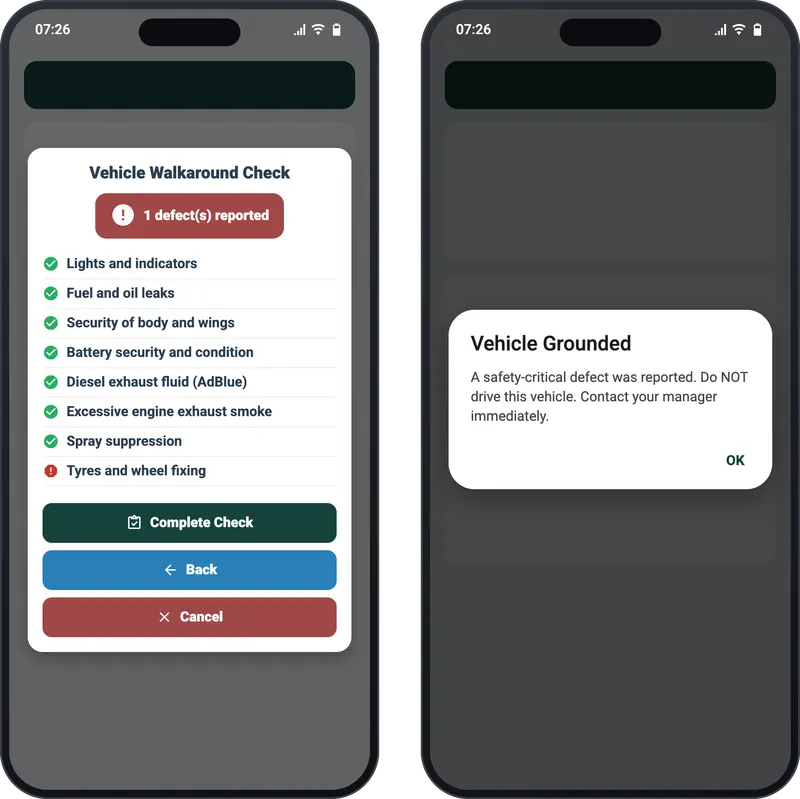
- Walkaround checks from the driver app. Drivers complete the DVSA walkaround check on their phone, in DVSA order, before the trip. Each check records the driver, the vehicle and trailer, the odometer reading, and the time, and it saves even without a signal, syncing when the phone is back online.
- Defects with photos and a status. A defect is graded minor or safety critical, described and photographed. A safety-critical defect tells the driver the vehicle is grounded. Each defect carries a status, from open to rectified.
- Checks on each vehicle's record. Walkaround checks are listed against the vehicle, so the history for one vehicle is in one place.
- Vehicle data from DVLA. One button fetches a vehicle's tax status and due date and its MOT status and expiry date from DVLA.
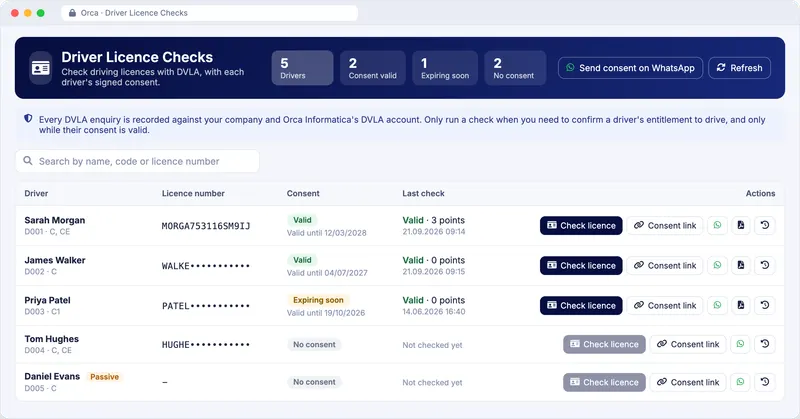
- Driver licence checks with a history. DVLA licence checks run from Orca, and each one records who ran it, when, under which consent and what DVLA returned.
- Expiry alerts. Each morning Orca messages the fleet manager on WhatsApp about driver licences, insurance and right to work documents that have expired or expire within 2 months.
Orca does not replace your maintenance provider's safety inspection records or your tachograph analysis. Keep those, and keep them for the full period. What Orca does is bring the driver, vehicle and trip side into one place, so the gaps between those records are much harder to fall through.
A monthly record keeping review
- Compare each vehicle's inspection dates with the interval on your licence.
- Check every defect reported this month has an outcome.
- Look for drivers who never report a defect, and ask why.
- Confirm every driver's licence was checked in line with your policy.
- Check drivers' hours infringements were followed up with the driver.
- Pull the full record for one vehicle at random, as DVSA would.
- Note what you found and what you changed. That note is evidence too.
For the daily side of this, see our guide to the DVSA walkaround check, and for drivers, how often to make driver licence checks.
Frequently asked questions
How long must operators keep vehicle maintenance records?
At least 15 months. That covers safety inspection records and driver defect reports with their repair details, and it applies to vehicles you have sold or removed from the licence as well.
Are electronic maintenance records acceptable?
Yes. DVSA's Guide to maintaining roadworthiness accepts electronic records, as long as they are available for the full 15 months along with the record of any repair.
What happens at a Traffic Commissioner public inquiry?
The Traffic Commissioner hears the evidence, usually from DVSA, and the operator's response, then decides whether to take action. Outcomes range from no action or a warning to curtailing, suspending or revoking the licence, and disqualifying the operator or transport manager.
How long should drivers' hours records be kept?
The Senior Traffic Commissioner's guidance on transport managers says drivers' hours records should be kept for no less than 12 months.
What do Traffic Commissioners mean by effective systems?
Systems that plan inspections and checks ahead, record them when they happen, make sure every defect is dealt with, and let the operator produce the evidence quickly. The test is whether they work in practice, not whether they exist on paper.
Orca brings walkaround checks, defects, driver licence checks, vehicle data and trips into one system for UK operators. See Orca for transport and logistics, or get in touch to see how it fits your operation.