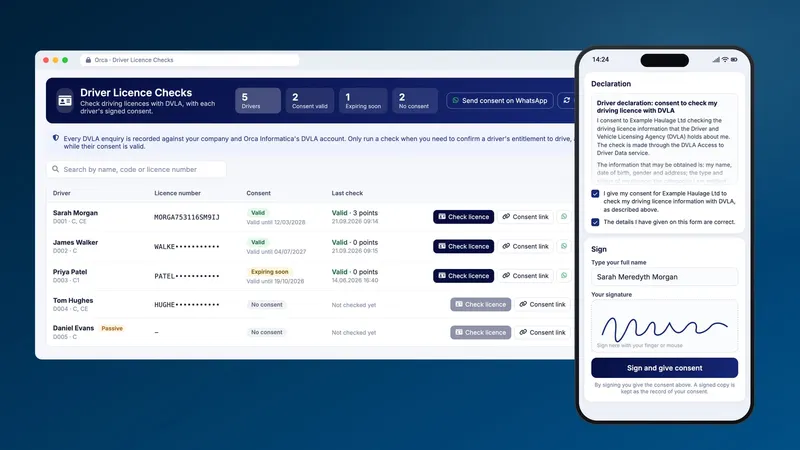
Driver licence checks are how an employer confirms that everyone who drives for them holds the right licence for the vehicle, with no disqualification and no surprises in their penalty points. In the UK the law is simple: you must make sure that anyone you employ to drive has the right licence and qualifications. The only reliable way to know that is to check the licence with the Driver and Vehicle Licensing Agency (DVLA), with the driver's consent, and to keep checking.
This guide covers what the rules say, the ways to check a licence, how often to do it, what to look for in the result, and how Orca turns the whole process into a few taps for the office and the driver.
Why driver licence checks matter
A driving licence can change at any time. Points are added, categories expire, and drivers get disqualified. None of it shows on the photocard in a driver's wallet. If a driver is disqualified, or not entitled to the category of vehicle you give them, you are the one who put them on the road.
The rules come from several directions:
- GOV.UK: employers must make sure that anyone they employ to drive has the right licence and qualifications, including Driver CPC for professional lorry, bus and coach drivers.
- Health and safety: the Health and Safety Executive (HSE) says you must assess workers' competence and make sure licences, insurance and MOTs are legal and up to date, and that driving offences are considered.
- Operator licensing: a transport manager must have continuous and effective control of the transport operation, which includes making sure drivers hold valid licences. See the Senior Traffic Commissioner's statutory guidance on transport managers.
For a transport business, a driver without the right entitlement is not just a fine waiting to happen. It raises difficult questions with your insurer after an accident, and with the Traffic Commissioner about your operator licence.
What a licence check tells you
A check against DVLA's records shows what the plastic card cannot:
- the licence status (for example valid, revoked or disqualified) and type
- the categories the driver is entitled to drive, with the dates they start and end, and any restrictions
- endorsements: the offence, the dates and the penalty points
- any disqualification
- for professional drivers, Driver CPC and tachograph card details, where these are included in the check
Two numbers deserve attention. A driver can be disqualified with 12 or more penalty points within 3 years, and endorsements stay on the record for 4 or 11 years depending on the offence. And a professional driver needs 35 hours of periodic training every 5 years to keep their Driver CPC: driving professionally without it can mean a fine of up to £1,000.
Lorry and bus entitlements also expire on their own schedule. They are usually valid until the driver is 45, then need renewing every 5 years until 65, then every year.
How to check a driving licence with DVLA
There are three official ways to do it.
1. The driver shares a check code
The driver goes to GOV.UK and creates a licence check code, which they give to you. You then view their record online, free of charge. A check code is valid for 21 days. This works for the odd check, but it depends on the driver doing it every time, and on someone in the office chasing them.
2. By phone or post
DVLA also offers checks by phone or post. Call charges apply, and a check by post costs £5. It is slow, and leaves you with paper to file.
3. Access to Driver Data (ADD)
For businesses that check licences regularly, DVLA runs Access to Driver Data, a direct connection to its records. There is an enquiry fee of 60 pence per driver record, but a company needs to pass DVLA's accreditation and sign a contract with DVLA before it can use it.
ADD comes with firm rules. You may only check a driver who has signed a data protection declaration giving their consent, and DVLA provides a standard declaration for it. The data must only be used to check entitlement to drive, never for identity checks. And GOV.UK is blunt about the alternative: it is a criminal offence to obtain someone else's personal information without their permission.
How often should you check driving licences?
There is no single legal frequency. GOV.UK says what you must achieve (every driver holds the right licence) but not a fixed interval. What that means in practice is that you need to be able to show a Traffic Commissioner, an insurer or the HSE that your checks are frequent enough to catch a change.
A sensible, risk-based approach:
- Before a driver's first shift. Never let someone drive on the strength of a photocopy.
- At regular intervals for everyone, with the interval set in your own policy and applied consistently.
- More often for higher risk drivers, such as those with penalty points or entitlements close to expiry.
- After any incident, or whenever you have reason to think something has changed.
Whatever you choose, write it down and be able to prove you followed it.
Keeping the records
Keep evidence of three things for every driver: the signed consent, each check you made (who ran it, when and what it showed), and what you did about anything it found. Licence data is personal data, so it must be handled in line with the UK GDPR, kept secure and only seen by people who need it.
How Orca makes licence checks easy, and trackable
Orca has DVLA licence checks built in, running through Orca Informatica's own Access to Driver Data account. That means you get direct DVLA checks without going through DVLA's accreditation yourself.
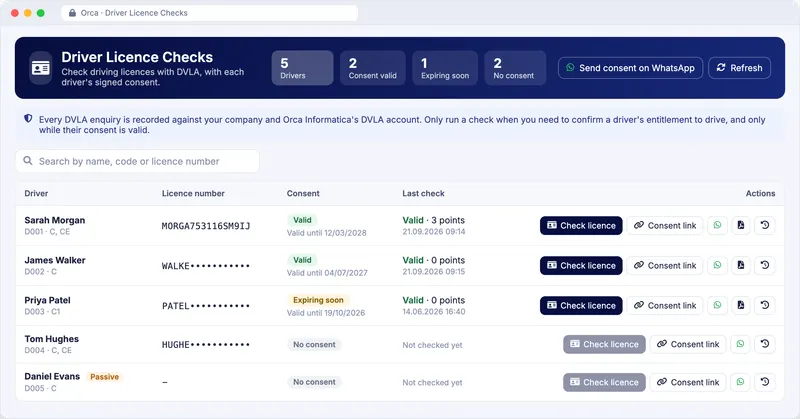
One screen for every driver
The Driver Licence Checks screen lists every driver with their licence number, whether their consent is valid, when it runs out, and the result of their last check, including penalty points. The counts at the top show at a glance how many drivers have a valid consent, how many consents are expiring soon and who has none, and each one filters the list.
Consent collected on the driver's phone
Consent is the step that usually stalls. In Orca you send the driver a consent link straight from the screen, on WhatsApp or by copying the link into any message. You can even add a new driver there, before their first day. The driver opens the link on their phone, confirms their details and signs with their finger.
The page checks the details as they type: the licence number must have 16 characters and match their date of birth, the postcode must be a real UK format, and the signed name must match the driver's name. The link works for 7 days and can only be signed once.
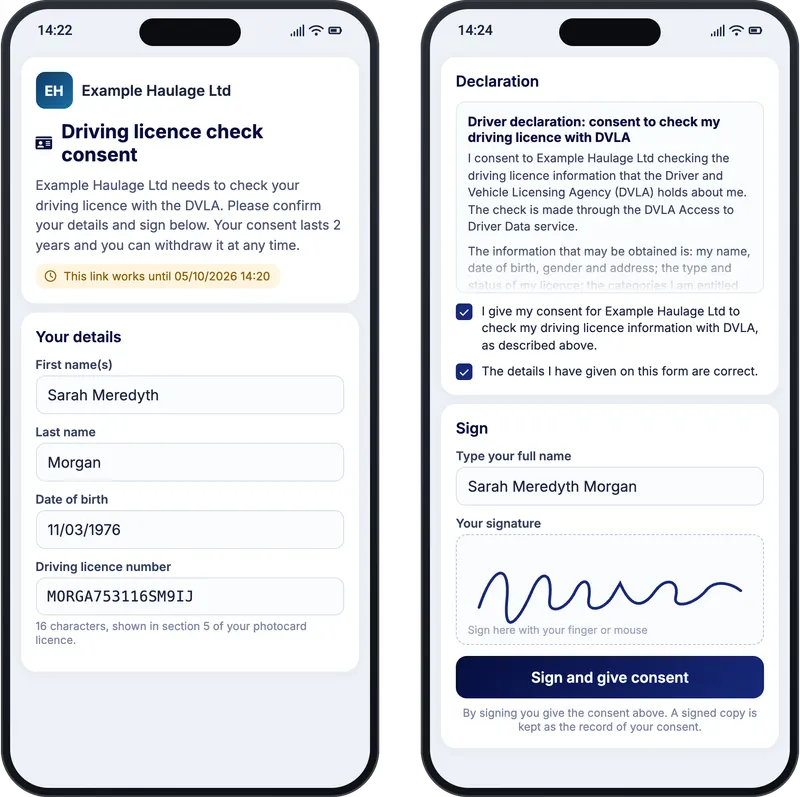
The signed declaration is saved as a PDF, which you can open at any time, and it records exactly which wording the driver agreed to. A consent lasts 2 years. If a driver withdraws it, you record that in Orca and no more checks can be run until they sign again.
Checks with the full DVLA record
With a valid consent, a check is one click. You confirm that it is needed to confirm the driver's entitlement to drive, choose whether to include Driver CPC and tachograph cards, and the DVLA record comes back laid out to read: licence status and type, penalty points, photocard validity, every entitlement with its dates and restrictions, endorsements with offence codes and dates, and a clear warning if the driver is disqualified.
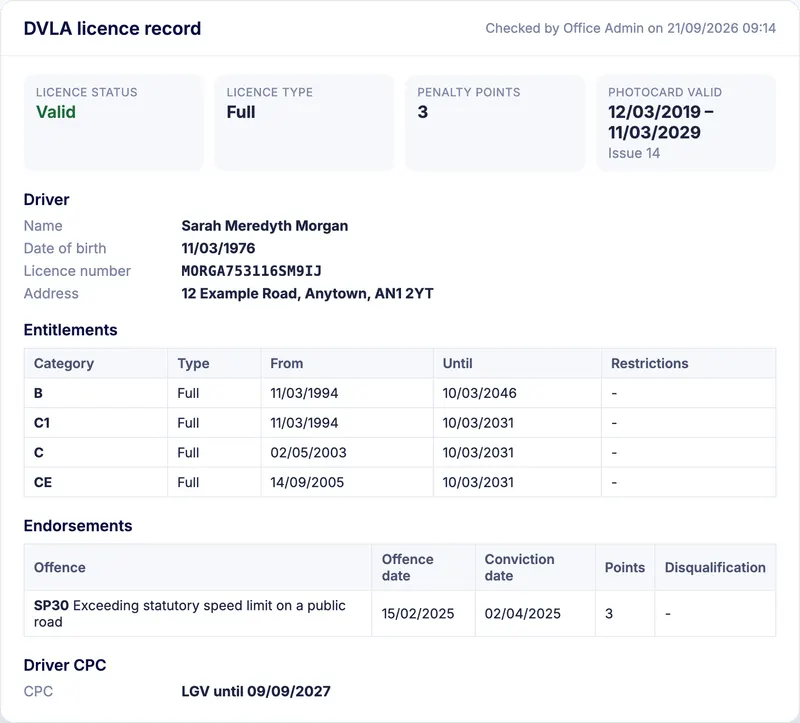
Orca will not run a check without a live consent, so you cannot make an enquiry you are not allowed to make.
Every check on record
Every enquiry is recorded: who ran it, when, under which consent and what DVLA returned. Each driver has a history of their signed consents and all their checks, so when anyone asks how you know a driver was entitled to drive on a given day, the answer is a click away.
Alerts before documents run out
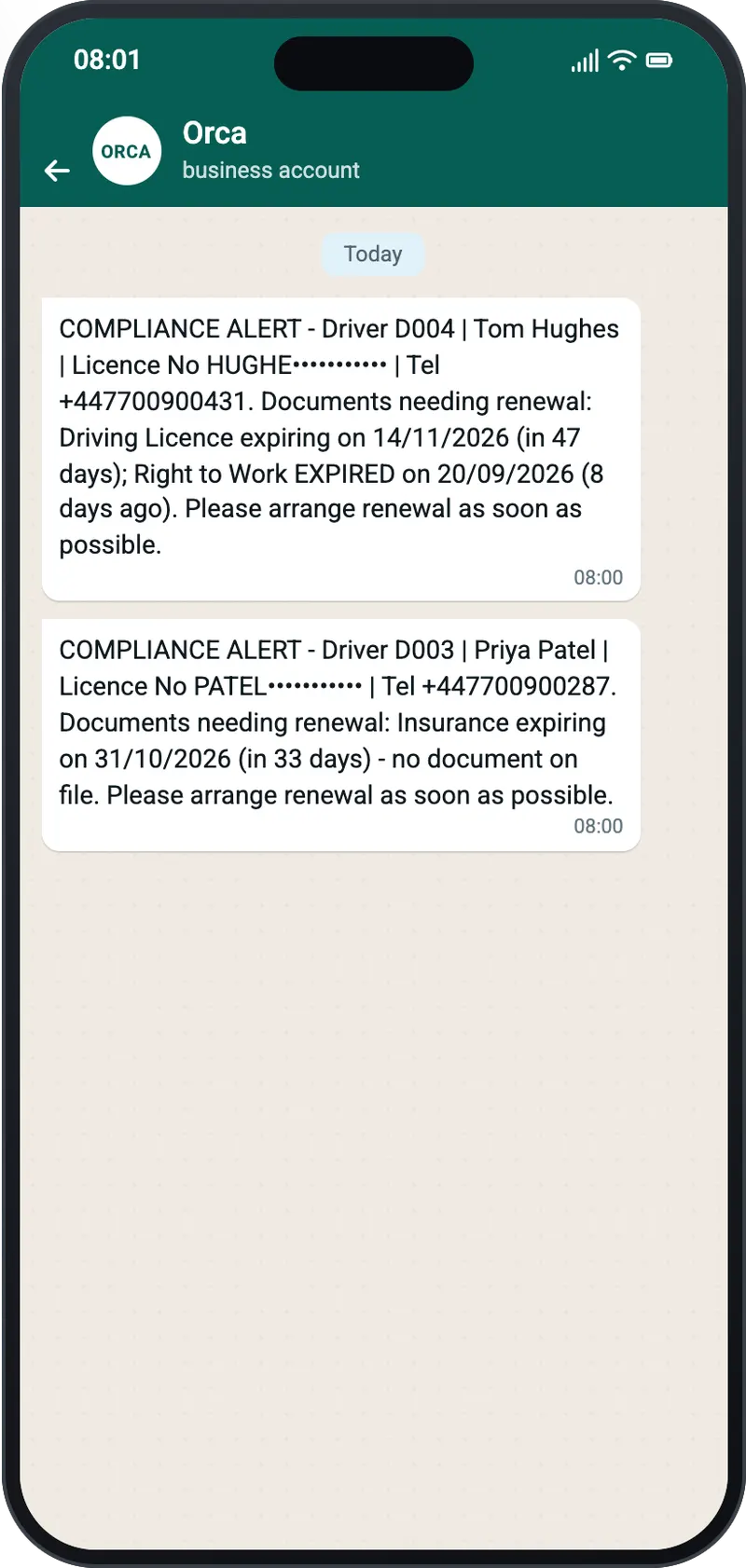
Licence checks are one part of driver compliance. Orca also keeps each driver's compliance documents with their expiry dates: driving licence, insurance and right to work. Every morning (at 8:00 by default), Orca checks them all and sends the fleet manager a WhatsApp message listing anything that has expired or expires within the next 2 months, and points out where the document itself has not been uploaded. You can also run the same check on demand.
The operations dashboard adds a single figure to watch: the share of your active drivers with an in-date licence on file.
A driver licence check routine that holds up
- Collect consent before a driver's first shift, and never let them drive before the first check.
- Put your check frequency in writing, with extra checks for drivers with points.
- Check Driver CPC and tachograph cards for professional drivers, not just the licence.
- Keep every consent, check and follow-up action, and be able to find them.
- Chase consents before they expire, not after.
- Track licence, insurance and right to work expiry dates, and act before they lapse.
Licence checks sit alongside vehicle checks in any compliance system. For the vehicle side, see our guide to the DVSA walkaround check.
Frequently asked questions
Is it a legal requirement to check employees' driving licences?
You must make sure that anyone you employ to drive has the right licence and qualifications. Checking the licence with DVLA is the reliable way to know that, and it is what an insurer, the HSE or a Traffic Commissioner will expect to see.
How often should an employer check a driving licence?
There is no fixed legal interval. Check before a driver starts, then at regular intervals set out in your own policy, more often for drivers with penalty points, and after any incident.
Do I need the driver's consent to check their licence?
Yes. Checks through DVLA's Access to Driver Data service can only be made for a driver who has signed a declaration giving consent, and it is a criminal offence to obtain someone's personal information without their permission.
How long is a DVLA licence check code valid?
A check code the driver creates on GOV.UK is valid for 21 days.
Can I check Driver CPC and tachograph cards too?
Yes. In Orca you can include Driver CPC and tachograph cards in a check, so professional drivers' qualifications are confirmed at the same time as their licence.
How many penalty points lead to a ban?
A driver can be disqualified with 12 or more penalty points within 3 years.
Orca brings driver licence checks, walkaround checks, route planning and live tracking into one system for UK operators. See Orca for transport and logistics, or get in touch to switch on DVLA licence checks for your drivers.