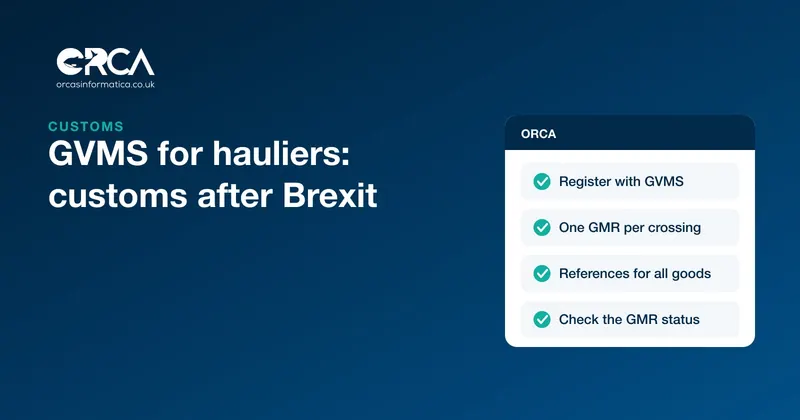
The Goods Vehicle Movement Service (GVMS) is HMRC's system for moving goods through ports that use it, including the main routes between Great Britain and Europe. For a haulier, GVMS comes down to one job: before the vehicle reaches the port, create a Goods Movement Reference (GMR) that links the vehicle or trailer to the customs declarations for every consignment on board. The carrier will not let a vehicle board without a valid GMR, and it is the haulier's job to check its status during the crossing and follow any instruction to attend a customs inspection.
This guide explains how to register, what goes into a GMR, the basics of transit, who is responsible for what, and the problems that most often hold a vehicle at the border.
Registering for GVMS
GOV.UK's registration requirements say that whoever moves goods through a GVMS port must register, which is generally the haulage firm that physically moves the goods, though it can also be a customs agent. To register you need:
- a GB EORI number (Economic Operator Registration and Identification)
- a Government Gateway account
- a business address that matches the one on that Government Gateway account
Hauliers can then use GVMS in two ways: through the online service, or directly from their own software through HMRC's haulier API.
The Goods Movement Reference
You get a goods movement reference in GVMS for each crossing. What goes into it depends on the route and the goods, but in general:
- the vehicle registration number for an accompanied movement, or the trailer or container number for an unaccompanied one
- a reference for all the goods in the vehicle, trailer or container,
for example:
- the import Movement Reference Number (MRN) from the Customs Declaration Service
- an MRN from the New Computerised Transit System (NCTS) for goods moving under transit
- ATA or TIR carnet references, with the paper carnet travelling with the goods
- safety and security declaration references, and export references where needed
Each GMR covers a single crossing and can be used only once.
At the port
At the port of departure you present the GMR to the carrier, the ferry or tunnel operator, who checks it in. The carrier will turn away a vehicle without a valid GMR. During the crossing, the haulier must check the GMR's status. If the goods are selected for a check, the driver must follow the instructions and attend Border Force or an inland border facility.
Transit in brief
Transit, under the Common Transit Convention, lets goods travel under customs control without paying import duties at each border, with the duties settled at the destination. For a haulier:
- the transit declaration is made in NCTS, which produces an MRN
- that MRN goes into the GMR for a movement through a GVMS port
- if NCTS is unavailable at the office of departure, an offline Transit Accompanying Document is needed
GOV.UK has specific guidance on travelling under transit using GVMS.
Who does what
Getting goods across a border involves several people, and delays often happen in the gaps between them.
| Who | Main responsibility |
|---|---|
| Trader (importer or exporter) | Makes sure declarations are made, usually through a customs agent |
| Customs agent | Prepares and submits the declarations and passes the references to the haulier |
| Haulier | Creates the GMR with references for all goods, checks its status and follows instructions |
| Driver | Carries the documents, presents the GMR and goes where directed |
| Carrier (ferry or tunnel) | Checks in the vehicle and turns away any without a valid GMR |
GOV.UK's guidance on the obligations of each party makes clear that hauliers are responsible for entering all vehicle and declaration reference numbers into GVMS.
International removals: household goods
For international movers, a customer's furniture and belongings are goods like any other when they cross a border, and need declarations. When people move their home to Great Britain, they may be able to claim Transfer of Residence relief from import duties on their belongings. It must be approved by HMRC before the goods are shipped, using a ToR1 application, and the removal company or its agent will need the customer's reference number for the import declaration. Without it, the customer may be billed for import duties.
The operator licence side matters too. Carrying a customer's belongings to Europe in a lorry, or in a van over 2.5 tonnes, needs a standard international operator licence. See do removal companies need an operator licence.
Common causes of delay
GOV.UK's guidance on international road haulage notes that drivers can be sent to an inland border facility if they are not border-ready, or for a document or physical inspection. In practice, the usual causes are:
- A missing reference. One consignment on a groupage load has no declaration, so the GMR cannot be completed.
- References arriving late from the customs agent, after the driver has left for the port.
- Wrong vehicle or trailer number on the GMR after a last-minute swap.
- Paper carnets left behind, when an ATA or TIR carnet must travel with the goods.
- Nobody checking the GMR status, so an instruction to attend an inspection is missed.
- Driver documents, such as an expired Driver CPC card or a missing international driving permit where one is needed.
- Disruption at Dover or the tunnel, when Operation Brock applies to HGVs over 7.5 tonnes.
A pre-departure checklist
- Every consignment on the vehicle has a declaration reference.
- The GMR has the right vehicle registration, or trailer or container number.
- Transit MRNs, carnet references and safety and security references are in.
- Paper carnets are with the driver.
- The driver has their passport, licence, Driver CPC card and any permits.
- Someone in the office will watch the GMR status during the crossing.
- Contact details for the customs agent are with the driver.
How Orca keeps the paperwork tied to each shipment
Orca does not create GMRs or customs declarations, but it keeps the shipment record that the customs paperwork hangs on.
- Orders with references. Each order can carry a reference number and records whether the customer has an EORI number, so the office can see which consignments need chasing before the trip.
- Trips with the vehicle and trailer. Each trip records the vehicle, the trailer, the driver, the dates and its reference, the details that must match the GMR.
- Customs costs on the trip report. The trip freight report totals the customs costs for each side of the journey, so the cost of clearance is visible per trip.
- Driver documents tracked. Driver licence, insurance and right to work expiry dates are checked every morning, and DVLA checks can include the driver's Driver CPC.
When every consignment on a trip is in one place, it is much easier to see the one that is missing a declaration before the vehicle leaves.
Frequently asked questions
What is GVMS?
The Goods Vehicle Movement Service is HMRC's system for moving goods through ports that use it. Hauliers use it to create a Goods Movement Reference that links the vehicle to the customs declarations for the goods on board.
Who creates the Goods Movement Reference?
Usually the haulier. GOV.UK says haulage companies are responsible for entering all vehicle and declaration reference numbers into GVMS, though a customs agent can also register and do it.
What do I need to register for GVMS?
A GB EORI number, a Government Gateway account, and a business address that matches the one on that account.
Can one GMR be used for more than one crossing?
No. Each GMR covers a single crossing and can be used only once.
What happens if my GMR is selected for inspection?
The driver must follow the instructions given and attend Border Force or an inland border facility for the check. It is the haulier's responsibility to check the GMR's status during the crossing.
Orca brings orders, trips, vehicles and driver compliance into one system for UK operators, including international cargo firms. See Orca for transport and logistics, or get in touch to see how it fits your routes.