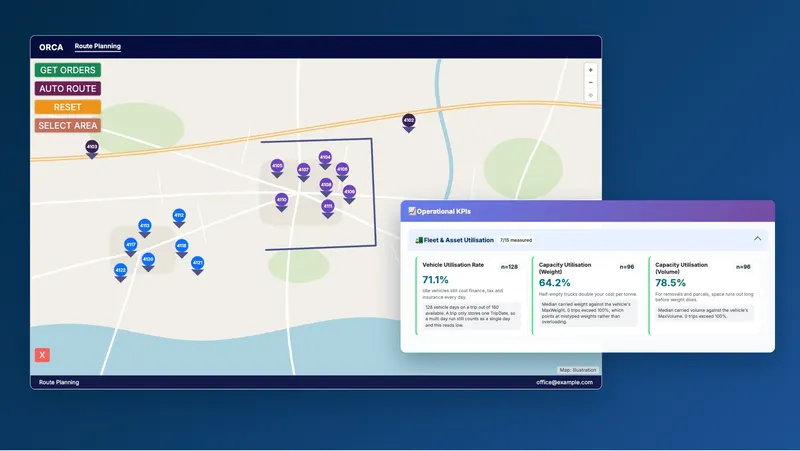
For a small haulage business, cutting fuel costs and cutting carbon emissions are not two competing jobs. On a diesel fleet, almost all of your carbon comes out of the exhaust, so every litre you do not burn is money kept and about 2.58 kg of carbon dioxide equivalent (CO2e) never made. If survival is the priority this year, and for most small operators it is, the fuel bill is also the best climate plan you can afford.
This guide is for operators who feel they are being asked to choose between paying the bills and caring about the environment. It covers why carbon has slipped down the list, who actually has to report it, the changes that save fuel and carbon together, and a monthly routine that takes less than an hour.
Why has carbon dropped down the list for small hauliers?
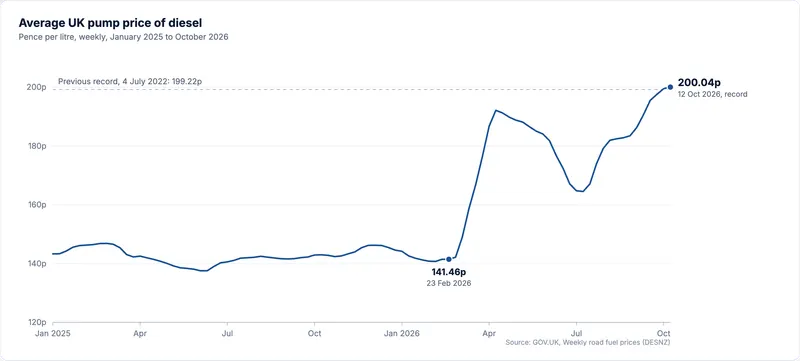
Because fuel has become the problem in front of everyone. The government's weekly road fuel price statistics put the average UK pump price of diesel at 200.04p a litre on 12 October 2026, the highest in the series. On 23 February 2026 it was 141.46p. That is a rise of almost 59p a litre in under 8 months.
Most of the operators we work with are small businesses, and the conversation is the same everywhere. Their customers want the cheapest rate, so they want the cheapest fuel. Nobody is asking them for a carbon figure, and when costs move this fast, measuring emissions feels like something for later, or for someone bigger.
That reaction is understandable, and in one sense it is right: a small operator should not spend money on carbon reporting before it has its costs under control. Where it goes wrong is the assumption that the two are separate. They are not.
Do small haulage companies have to report their carbon emissions?
Usually not, by law. The UK's Streamlined Energy and Carbon Reporting (SECR) rules apply to quoted companies and to large unquoted companies and limited liability partnerships. Under the government's environmental reporting guidelines, a company counts as large when it meets at least 2 of these 3 tests:
- 250 or more employees
- turnover of £36 million or more
- a balance sheet total of £18 million or more
Most small hauliers, removals firms and courier businesses are nowhere near those thresholds.
The pressure can still reach you through your customers. Under PPN 006, suppliers bidding for central government contracts worth more than £5 million a year must publish a Carbon Reduction Plan. The technical standard for those plans includes upstream and downstream transportation and distribution, which is the work you do for them. So the large firm you subcontract to may one day ask how much fuel you burn on its loads. You do not need a consultant to answer that, as the routine below shows.
Why is fuel saved the same as carbon saved?
The government publishes the figures companies use to turn fuel into emissions. In the 2026 greenhouse gas conversion factors, 1 litre of forecourt diesel (the average biofuel blend) produces 2.58 kg CO2e when it is burnt.
At 200.04p a litre, a VAT-registered business pays about £1.67 a litre before VAT. So a single litre saved is worth roughly £1.67 and 2.58 kg CO2e. Here is what that looks like per vehicle over a 48-week working year:
| Litres saved per vehicle per week | Litres per year | Saved before VAT | CO2e avoided |
|---|---|---|---|
| 5 | 240 | £400 | 620 kg |
| 10 | 480 | £800 | 1.24 tonnes |
| 20 | 960 | £1,600 | 2.48 tonnes |
These are worked examples, not promises: your saving depends on your vehicles, your routes and your starting point. The point is the shape of the table. The money column and the carbon column always move together. You cannot cut one without cutting the other.
That is why the dilemma in the title is mostly a false one. For a small operator, the realistic climate plan for the next 12 months is not a new electric fleet. It is burning less diesel, and that is exactly what keeps the business alive.
Six changes that cut fuel costs and carbon emissions together
1. Plan routes properly, and put the stops in order
Miles are fuel. A driver who zig-zags between drops because the paperwork came in that order burns diesel for nothing. Grouping jobs by area before you build trips, and running the stops in a sensible order, is the cheapest saving there is.
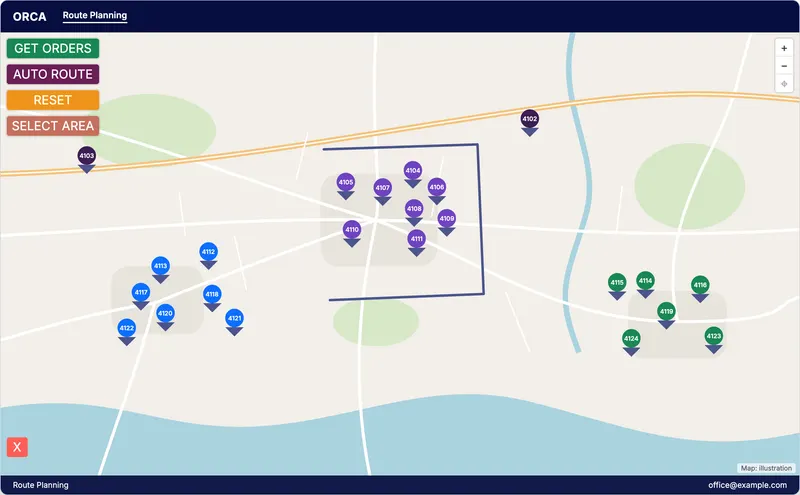
In Orca, the Route Planning screen puts your open orders on a map. Auto Route groups the orders that sit close together and colours each group, so you can see natural trips at a glance. Select Area lets you draw round a group and create a trip from the orders inside it, or add them to a trip you already have. Once a trip is built, its Auto Route action puts the stops in order for you: the drop nearest the depot first, then each time the closest remaining drop.
2. Fill the vehicle before you add another one
A half-empty truck still burns most of the fuel a full one would, so the fuel and carbon behind each pallet go up sharply. Before sending a second vehicle, check whether the loads fit in one.
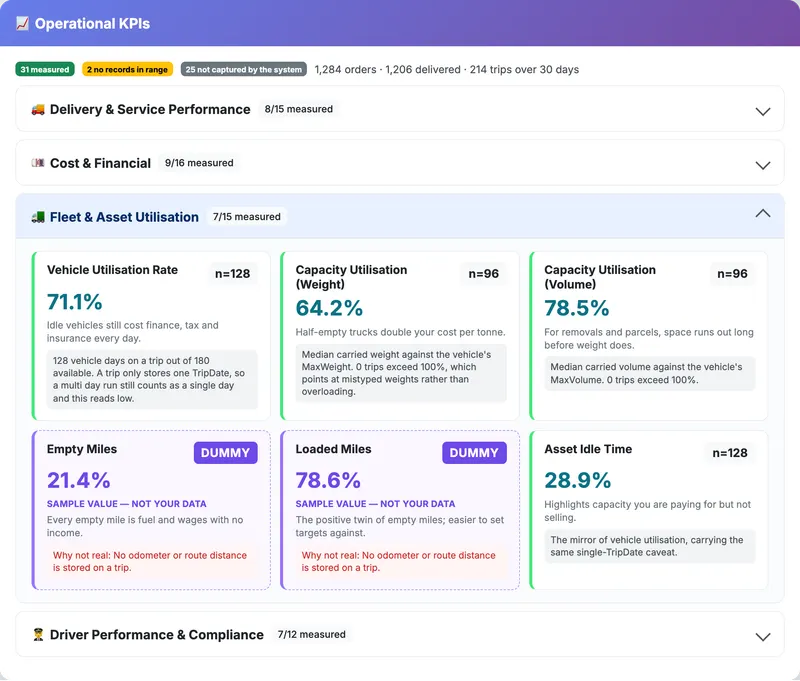
Orca's dashboard measures this from your own trips. Capacity Utilisation (Weight) and Capacity Utilisation (Volume) compare what each trip carried with the vehicle's maximum weight and volume, and Vehicle Utilisation Rate shows how many of your available vehicle days were actually spent on a trip. If utilisation is low, you are paying for fuel, finance and insurance on capacity you are not selling.
3. Switch off when the vehicle is parked
Idling burns fuel and goes nowhere. It is also covered by rule 123 of the Highway Code: you must not leave an engine running unnecessarily while the vehicle is stationary on a public road, and if you expect to be stationary for more than a couple of minutes you should switch off. Make it part of driver briefings, especially for waiting at customer sites and loading bays.
4. Keep vehicles in good condition
Under-inflated tyres and dragging brakes make the engine work harder on every mile. The daily walkaround check is where these problems get spotted, and it is a legal duty anyway. Our guide to the DVSA walkaround check covers all the items, including tyres and wheel fixings, and how drivers do it on their phone in the Orca app.
5. Look at how your drivers drive
Hard acceleration, late braking and high motorway speeds all cost fuel. Talk about it openly, praise the drivers who drive smoothly, and use your Driver Certificate of Professional Competence (CPC) training time on it. If you have telematics, watch the trend rather than single events.
6. Cut out wasted journeys
A failed delivery means a second trip for the same load, which is double the fuel for one invoice. Confirm delivery windows with the customer, and make sure the driver has the right contact details before setting off. Answering customers quickly helps too: our post on WhatsApp and email in one inbox shows how Orca keeps those conversations in one place.
What about electric trucks and renewable fuel?
They are part of the long-term answer, and you should look at them each time you replace a vehicle. But they cost more up front today, and the charging or supply has to fit your routes. For most small operators, the honest position for the next year is to get the most out of the vehicles they already have, and to make the switch when the numbers work.
When you do compare vehicles, Orca keeps the details the Driver and Vehicle Licensing Agency (DVLA) holds for each one, including the fuel type and, where DVLA has one, the CO2 figure, alongside the rest of your fleet records.
What goes wrong when survival and climate are treated as separate?
- Chasing the cheapest litre. A detour to save 3p a litre can burn more fuel than it saves. The cheapest fuel is the fuel you do not use.
- Running vehicles half-full to keep every customer's job separate, then wondering why fuel is eating the margin.
- Ignoring the question until a tender asks it. When a large customer wants your emissions, you want an answer ready in minutes, not a scramble through a year of fuel card statements.
- Waiting for a big investment before doing anything, when the first savings need no investment at all.
A monthly fuel and carbon routine that takes under an hour
- Total your litres. Add up the diesel from your fuel card statements and receipts for the month.
- Work out your carbon. Multiply the litres by 2.58 to get kg CO2e, using the figure from the GOV.UK conversion factors. Check the factor each year, as it is updated every summer.
- Divide by your work. Litres per delivery, per trip or per pallet. This is the number to improve, because it does not punish you for growing.
- Check utilisation. Look at capacity and vehicle utilisation on your Orca dashboard. Are trucks going out light?
- Pick one change from the list above for next month, and tell the team.
- Keep the figures. 12 months of litres, carbon and litres per delivery is a perfectly good answer when a customer asks.
Orca does not calculate a carbon figure for you. You do not need it to: your fuel card statement and one government number are enough to start.
Frequently asked questions
Do small haulage companies have to report carbon emissions?
Not usually. Mandatory reporting under SECR applies to quoted companies and to large companies and LLPs, meaning at least 2 of: 250 employees, £36 million turnover or an £18 million balance sheet. Large customers may still ask you for figures for their own reporting.
How do I work out the carbon from my diesel?
Multiply the litres you bought by the government's conversion factor. For 2026 that is 2.58 kg CO2e per litre of forecourt diesel, so 1,000 litres is about 2.58 tonnes CO2e.
What is the cheapest way to cut a fleet's carbon emissions?
Use less fuel. Better route planning, fuller vehicles, no idling, well maintained tyres and smoother driving all cut fuel and carbon together, and none of them needs new vehicles.
Should a small operator switch to electric trucks now?
Only when it suits your routes and the numbers work. Compare running costs and the purchase price each time you replace a vehicle, and in the meantime get the most from the vehicles you have.
Why would a customer ask for my emissions?
Large companies report the emissions in their supply chain, including the transport they buy. Suppliers bidding for major government contracts must publish a Carbon Reduction Plan that covers transport and distribution, so they may ask their hauliers for fuel figures.
Does Orca calculate my carbon footprint?
No. Orca helps you use less fuel through route planning and utilisation figures, and keeps DVLA vehicle details including fuel type. The carbon figure itself comes from your fuel records and the GOV.UK conversion factor.
Surviving a year like this one and doing right by the environment turn out to be the same piece of work: fewer miles, fuller vehicles and less diesel. See how Orca for transport and logistics helps you plan better trips, or get in touch and we will show you the route planning screen with your own orders.